
MY TAKE ON "GEO"

Updated: Feb 1
Make no mistake, GEO (I think we are all agreeing this stands for generative engine optimisation) is a 'thing', if you consider a 'thing' to be an entity that people are actively researching, want more information on, or may want to invest in (no matter how misguided that desire might be).
You only need to look at Google Trends to see that there is now a general mainstream awareness of the term GEO, and that somehow, it's stuck

You might argue that people have always searched for 'GEO' (at least in the last 5 years) and that it's had a couple of short-term spikes recently (and you'd be right - maybe GEO means something else).
But look at the recent growth of the term 'AI Search'
Something is going on.

Every other post on LinkedIn is arguing either;
a. GEO is the future. SEO is dead. By 2028 no one will be using Google anymore. Invest in 'xxxx AI prompt Tracker' now or get left behind and end up living in a cardboard box
b. GEO is made up by grifters trying to con business owners with 'shiny object syndrome' out of their marketing budgets. People will never use ChatGPT to 'buy stuff', it's all hype, Google will continue to reign supreme
As with most fiercely debated topics, the answer probably lies somewhere in the middle.
My current opinion is more with the 'GEO is hype' crowd at the moment but please remember people are allowed to change their minds as new data emerges.
What I am certain about is that no one can legitimately call themselves a GEO/AI Search expert yet. This is an emerging field, and with no reliable way of gauging visibility accurately in LLMs, no one can prove that what they're doing (structured data, 'chunking' content) is actually having an impact.
the current reality
Below this the LLM session growth over 12 months for a travel company (the drop off at the end is because it's weekly data, and this week isn't complete yet)

Impressive? Maybe, but this is a tiny fraction of overall traffic despite the growth
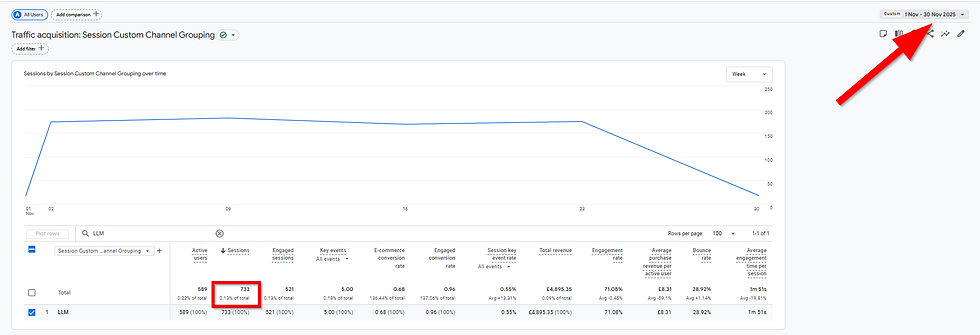
As you can see above, even as recently as November, LLM sessions only made up 0.13% of the total sessions. Booking and revenue share are similar

If you can't see that, here's a close-up, which also serves the dual purpose of labouring the point.
I'm sure there are some outliers, but I wouldn't be surprised if this is the situation for everyone at the moment. Right now, we can only really say that LLMs are worth keeping a watching brief on, that's the reality. There is not a huge opportunity to materially drive incremental revenue from this channel yet.
ARE LLMS A SALES CHANNEL?
Maybe not.
Maybe we're all waiting for traffic and conversions from LLMs to explode but maybe consumers will end up using LLMs like social media. A tool for research, planning and inspiration, rather than buying.
That could change as LLM usage grows, people get more comfortable with them, and the experience changes (e.g. Chat GPTs Shopify integration, or Google pushing AI Mode and introducing more links).
The commercial search experience in Chat GPT has come on leaps and bounds (see below) and I personally think this is a better interface than traditional Google search, especially if you have a very specific query or want to quickly compare options and do your research 'in-platform' without the added friction of visiting external sites.

But I'm a nerd that works in digital marketing, just because I like this experience (or even know it exists), it may take 'normies' years to realise that this is even possible, and by that point the default Google experience will likely look very different
THE BEST DATA WE HAVE
So if people aren't clicking on links and buying stuff from LLMs yet, how do we know we are laying the foundations for visibility and other more important metrics in future?
Enter Cloudflare.
Peopel may not be clicking on our links, but at least we can get an idea if our content is being used to form responses to prompts in LLMs.
The 'ChatGPT-User' bot reveals what content on your site ChatGPT is using to form its responses, and how often.

Above, we can see that the 'ChatGPT-User' bot made 420,000 requests over the last 30 days. So, although traffic is only coming through in dribs and drabs, we know that our content is being crawled/used an average of 14,000 times a day by ChatGPT to build its answers.
Does that mean our brand is being cited, linked to or clicked? No
But the more we get crawled, the higher the likelihood of those things happening is (probably).
Cloudflare also allows you to drill down and explore which content is being crawled the most

Using the data above, we could deduce that our blog content is highly regarded by ChatGPT, that it already ranks well (or better than other page templates) in Google which we know ChatGPT scrapes, or that people are mostly using ChatGPT for top-of-funnel research type queries (which blog posts obviously address well).
We can also filter to see specific URL paths in Cloudflare.
For example, the filter below is showing only commercial 'category level' or 'PLP' landing pages.

Because we can only ever see a maximum of 15 data points for any dimension, this reveals more data

The main limitation with Cloudflare data at the moment is that you can only access a maximum of 30 days, making month-on-month or year-on-year comparisons impossible. This could just be my restricted privileges, however.
This data is very limited and still not that useful, but at least it's real, which leads me onto...
WHAT WE SHOULD AVOID (FOR NOW)
The 'prompt tracker market is exploding.
Profound
Peec
LLMRefs
AccuLLM
Are just a few on the market, claiming they can track your 'AI visibility.
The most significant limitation of these tools is structural: there is no direct access to LLM prompts or outputs at scale. Tools outside of OpenAI, Anthropic, or Google do not have visibility into what users ask, what the model retrieves, or how responses are generated.
As a result, prompt trackers cannot confirm:
Whether a specific prompt was asked
Whether answers to that prompt are cited or linked to your brand every time
Whether a particular source was used to generate the response
Any claim of “tracking prompts” is therefore based on external signals, not first-party data.
I tried LLMRefs because it's free, and below is an example of the prompt tracking data you have access to

You can enter several prompts and the tool will run these daily on various LLMs. This allows you to see the number of 'Brands' (mentions) and 'Sources' (linked URLs) per prompt. It will also tell you if your brand is mentioned

You can then drill down and view the exact response to each prompt in your desired LLM
Pretty cool, but the fundamental issue remains; we simply don't know what prompts are being used by real people, so any claim of 'visibility' is going to be a guess.
Interesting? Yes.
Useful? Not really.
KEEP A GRIP ON REALITY
We need to keep our eyes on this.
In 2, 3, 5 or 10 years, LLM traffic and conversions may eclipse Google traffic. Or maybe Google will still dominate with AI Mode
But that isn't the case now, and our clients or employers need to be generating revenue from search now.
ChatGPT might seem like it's going through a period of stratospheric growth...

But it's still insignificant compared to Google...
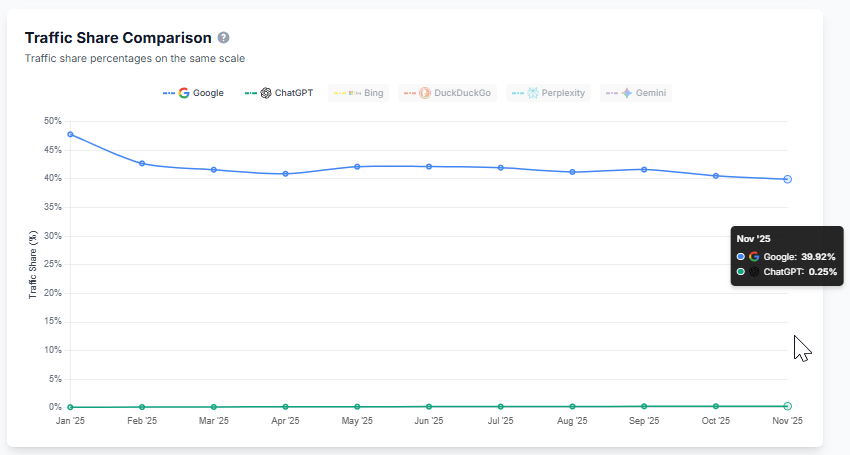
You can keep up with traffic share trends here: https://chatgpt-vs-google.com/
And for now;


Comments