
THE VALUE OF STATIC 'SEASONAL SALES' PAGES THAT LIVE FOREVER

Seasonal sales events like Black Friday, Cyber Monday, or January sales often lead marketing teams to make the same annual SEO mistake: creating a brand-new landing page each year, publishing it for a few weeks, then redirecting or removing it once the promotion ends.
For example:
/black-friday-deals-2022
/black-friday-deals 2023
/black-friday-deals-2024
ad infitum...
Even when redirects are implemented correctly, this approach quietly throws away one of the most valuable assets in SEO: accumulated trust and authority.
A more effective long-term strategy is to maintain one permanent sales page (for example, /black-friday-deals/) that remains live indefinitely and is reused year after year.
If you suspect you have an untapped opportunity to improve your seasonal sales pages, a content audit is something that may uncover that.
Search Engines Reward AGE AND Consistency
Google does not evaluate pages in isolation. Over time, it builds an understanding of which URLs are reliable, trustworthy, and useful to users. A permanent sales page benefits from:
Historical engagement signals
Consistent internal and external linking signals
Stable crawling patterns
Consistent indexation
Long-term relevance for recurring queries
Each year that a new URL is created, these signals reset. Even with a 301 redirect, some equity is lost, and, more importantly, trust signals have to be rebuilt. A single, long-standing page avoids this entirely.
A TRAVEL-INDUSTRY-SPECIFIC EXAMPLE
When I started working on Travel Republic, one of the first things I noticed was the opportunity to implement static sales pages, with Black Friday being one of the biggest opportunities (search interest was generally growing year on year since COVID)

In all honesty, this was a pretty quick and easy process.
Get some copy written up and approved
Get some offers approved by the product team
Build the page and launch
Ranking All Year Is a nice problem to have
A common concern is that a Black Friday page might rank outside of the sales period. In reality, this is not an issu, it is an advantage.
Seasonal queries follow predictable patterns. Google often rewards pages that have already demonstrated relevance and stability before peak demand begins.
Below are a few examples of Black Friday-related keywords that Travel Republic has ranked for consistenly for the past 12 months.
'black friday holiday deals'

'black friday holidays'

'black friday holiday deals 2025'
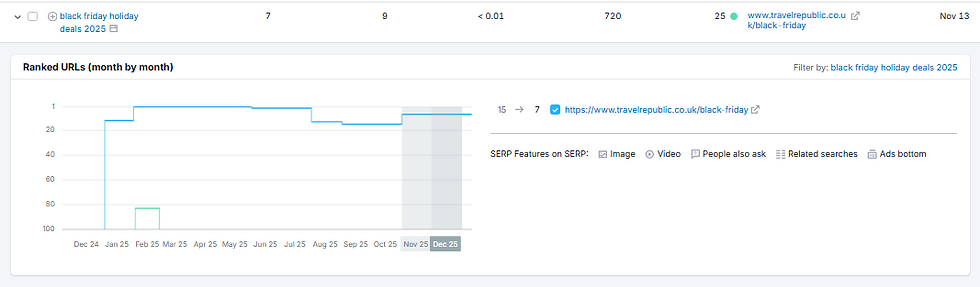
A page that ranks modestly throughout the year is far more likely to perform strongly when search interest spikes than a brand-new page published weeks before the event.
In SEO, being present early is often more valuable than appearing late.
Flexible Messaging Without Sacrificing SEO Value
A permanent sales page does not mean static content.
"Won't a black Friday page that's still live in July be confusing for customers?" is the common objection.
The simple answer is 'no'. No one on Google will be searching for such content; therefore, no one will find it unless;
a. They navigate through the site (unlikely as long as it's not being promoted on the homepage)
b. They've bookmarked the page or type the URL in manually (won't happen)
c. They find it via social media or email (if Black Friday is being promoted in July you need to have a word with the marketing team)
If a very slim chance of a negative customer experience is that much of a worry, outside of the active sales period, the page can be updated with alternative messaging, such as:
“Black Friday deals returning soon”
Email signup prompts or deal alerts
Outbound Internal links to other important pages
Highlights of previous offers
Related evergreen promotions
Crucially, the page should never be redirected, noindexed, or blocked. These actions break continuity and weaken the signals the page has built over time. Instead, content should evolve while the URL remains constant.
All these things also reduce the chances of the page naturally picking up more external links as time goes by.
Compounding Equity Year After Year
Each seasonal cycle strengthens the same page:
Internal links continue to point to a single URL
External links accumulate rather thanbeing spread thinly across multiple variations
Google becomes increasingly confident in the page’s purpose
By the time peak season arrives, the page is already trusted, crawled frequently, and well understood. This makes it far more likely to rank quickly and competitively when it matters most (or just maintain its already good rankings).
You can see this process playing out below (https://www.travelrepublic.co.uk/black-friday)

Unfortunately, 2025's performance was nowhere near 2024, but that was more to do with Google's perception of the site (more on that in this post)
The Long-Term SEO Mindset
The most effective SEO strategies are rarely about short-term wins. Treating seasonal sales pages as long-term assets rather than disposable campaigns aligns far better with how search engines evaluate quality and relevance.
One permanent “temporary” sales page may feel counterintuitive, but over time it delivers something far more valuable than yearly launches ever could: sustained trust, compounded authority, and consistent performance when demand peaks.


Comments